Akademien der Wissenschaften Schweiz a+
Nomadic concepts - td-net toolbox profile 13 Rossini, M. 2020
This publication describes the nomadic concepts tool and is part of a series of tools and methods compiled in the td-net toolbox for co-producing knowledge. Nomadic concepts is a heuristic tool for exchanging understandings of concepts across disciplinary, professional and cultural boundaries.
Nomadic concepts – also and perhaps better known as "travelling concepts" – are a heuristic tool and analytical practice for communicating across disciplinary, professional and cultural boundaries through discussing and opposing different understandings and uses of concepts such as identity, space or emotion. It could thus also be called a translation tool.
It was first proposed by Belgian philosopher of science Isabelle Stengers in her edited collection D’une science à l’autre: des concepts nomades (1987) where she defines the purpose of concepts that travel between and within the ‚hard’ and ‚soft’ sciences as opening up debates and facilitating invention.
Later, it was Dutch narratologist Mieke Bal who in her book Travelling Concepts in the Humanities: A Rough Guide (2002) described and indeed demonstrated how working with (and on) concepts in the humanities enables a thoroughly interdisciplinary and intersub- jective approach.
Humanities and Social Sciences Communications

Toolkitting: an unrecognized form of expertise for overcoming fragmentation in inter and transdisciplinarity
Laursen, B, Vienni-Baptista, B, Bammer, G, Di Giulio, A, Paulsen, T, Robson-Williams, M, Studer, S (2024)
A growing number of inter- and transdisciplinary (ITD) toolkits provide methods, processes, concepts, heuristics, frameworks, and other resources for designing and implementing ITD research. A brief overview of the currently fragmented toolkits landscape is provided, fleshed out through descriptions of four toolkits.
Gaia Ecological Perspectives for Science and Society
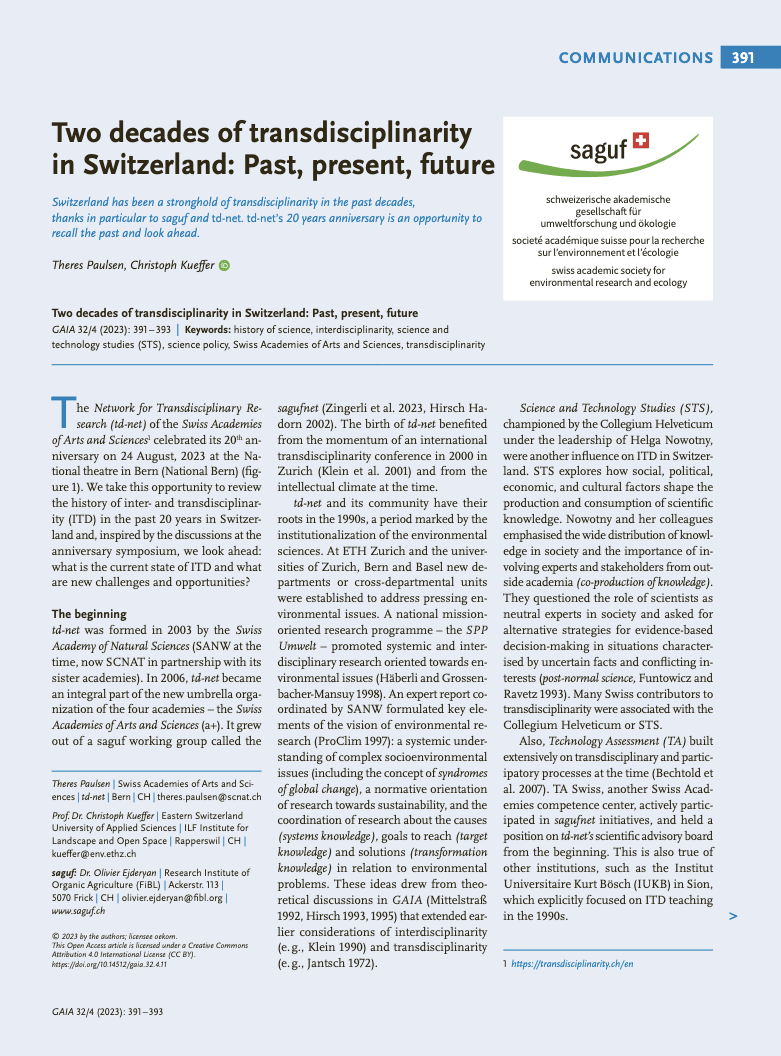
Two decades of transdisciplinarity in Switzerland: Past, present, future
Paulsen, T, Küffer, C (2023)
Switzerland has been a stronghold of transdisciplinarity in the past decades, thanks in particular to saguf and td-net. td-net’s 20 years anniversary is an opportunity to recall the past and look ahead.
Gaia Ecological Perspectives for Science and Society